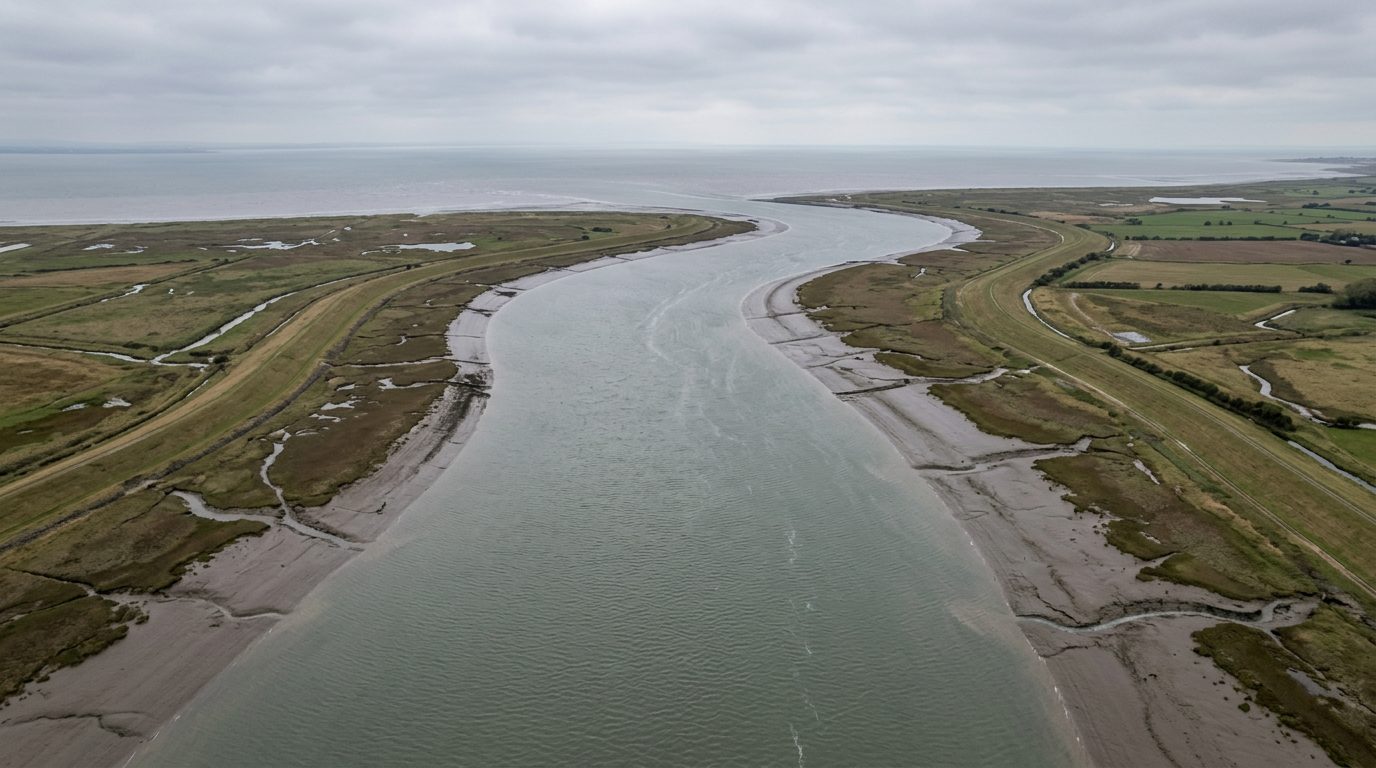
River incidents and developing fish stress
Catch the pollution before the plume disappears.
Continuous upstream and downstream monitoring can identify developing stress. Triggered sampling can preserve the water while the event is still passing. RippleXn connects that evidence with rainfall, flow, operations, alerts and response.
What we investigate
RippleXn River Guardian — Detection-Gap Assessment and Pilot. Three separate jobs: detect a developing change in the water, narrow where and when the event entered the river, and preserve a physical sample for accredited laboratory analysis.
Why river events are so rarely explained
A pollution event in a river is a moving object. It enters at one point, travels with the flow, dilutes and disperses. A discharge at two in the morning may be undetectable by the time anyone is standing on the bank with a bottle.
The fish are the first record, and they are a late one. By the time a kill is visible, the water that caused it is kilometres downstream and chemically unrecognisable. The investigation begins after the evidence has left.
Detection, location and sampling are three different problems, and they need three different answers. A sensor can tell you something changed. It cannot tell you what the substance was. Only a preserved sample and an accredited laboratory can do that — and the sample has to be taken while the event is passing, not after it.
An illustrative event chronology
At 02:14, dissolved oxygen fell downstream while conductivity changed. The upstream reference remained stable. A nearby operational record showed activity shortly beforehand. The automatic sampler, where included in the deployment, preserved samples during the event. The chronology narrows the time and candidate source area; laboratory analysis is required to identify an unknown contaminant.
Illustrative reconstruction. Not a measured RippleXn deployment.
The exact deployment is selected for the site. Not every river needs an automatic sampler, and not every question needs continuous monitoring. Sampling, calibration, maintenance and chain of custody must be professionally specified before any of this evidence is worth relying on.
What a qualified deployment can produce
- An upstream reference baseline and a downstream condition record
- Continuous parameter traces across the event window
- Alerts, with the time each threshold was crossed
- Rainfall, flow and water level for the same period
- Operational and discharge records aligned to the trace
- Preserved samples with documented handling, where sampling is included
The principal limitations
- A guarantee that every fish kill will be prevented
- The identity of a pollutant from a sensor anomaly alone
- The composition of an unknown substance without accredited laboratory analysis
Potential components of a river deployment
Open +
The exact deployment is selected for the site, the river and the question. Parameters are included where they are technically appropriate, not as a standard list.
What this can and cannot establish
Open +
What it can establish
- That a measurable change developed in the water, and when
- Whether the change was present upstream, or only downstream
- The direction of travel and approximate timing of the event
- A candidate source area, narrowed by reference monitoring and flow
- Whether rainfall or flow could account for the change
- Which operational records coincide with the event window
- The composition of a preserved sample, through an accredited laboratory
- How long elapsed between the first signal and the first response
What it cannot establish on its own
- A guarantee that every fish kill will be prevented
- The identity of a pollutant from a sensor anomaly alone
- The composition of an unknown substance without accredited laboratory analysis
- Legal responsibility — a stable upstream reading narrows the candidate source area, it does not by itself prove liability
- Anything reliable from sampling, calibration, maintenance or chain of custody that was not professionally specified
- The condition of a reach that was never monitored
Who this is for
- Water and wastewater operators
- Industrial sites beside rivers
- Inland-fisheries and local-authority teams
- Catchment bodies
- Developers and contractors working near sensitive water
- Insurers or operators responsible for high-risk discharge points
A sensible first engagement
Fish-Kill Detection-Gap Assessment
From €1,500
We assess what a developing event on your reach would currently look like — what would be detected, what would be missed, and how long the evidence would survive. The output is a detection-gap map and a proportionate recommendation for monitoring and sampling.
See how engagements workThe second price tag
Assessing a detection gap costs a known amount. A fish kill that nobody can attribute costs the prosecution, the remediation, the licence review and the reputation — and the bill arrives after the water has cleared.