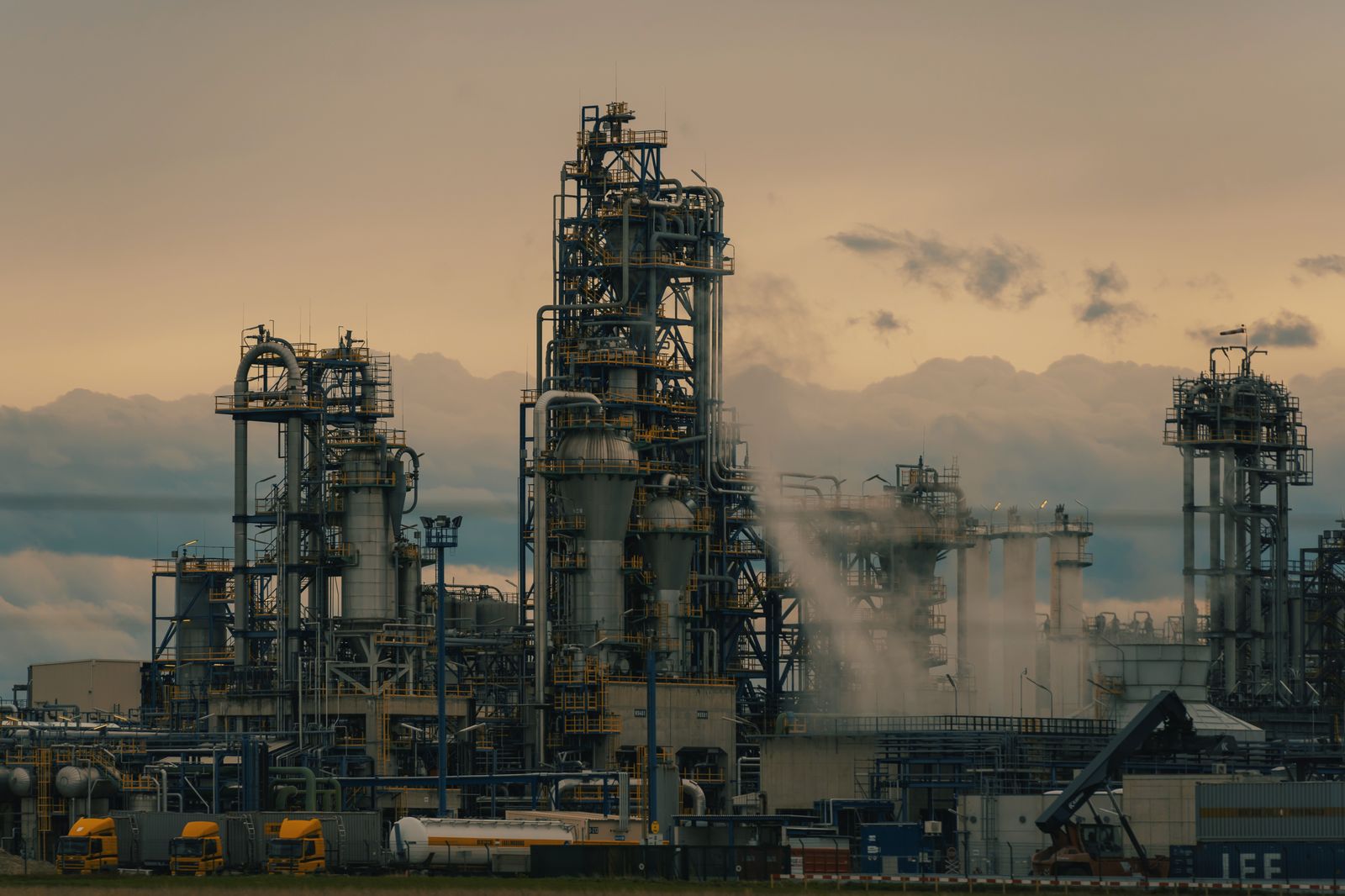
Industrial operations
The first sign of failure rarely appears in the system built to find it.
It appears in a neighbour's complaint, an operator's offhand remark, or a boundary reading nobody was watching that week.
Industrial sites do not suffer from a shortage of data. They suffer from data that was collected for a different purpose than the one it is later asked to serve. When something consequential happens, the evidence needed to explain it is scattered across equipment logs, maintenance records, environmental monitors, shift observations and management systems, each with its own clock and its own owner. We reassemble those fragments into one account that holds up outside the plant.
The questions that follow
- ?What changed, and when did it first change?
- ?Which equipment or process coincides with it?
- ?Was maintenance due, overdue, or just completed?
- ?Did anyone on shift notice before the system did?
- ?Did it cross the boundary, and where?
- ?Did complaints align with the physical record?
- ?How long between detection and response?
- ?Has the same signature appeared before?
Find what sits behind a recurring problem — and whether the fix held.
Explain a recurring complaint
Establish when the intermittent odour, noise, dust or discharge actually occurs, and in which conditions.
Connect the event to process activity
Compare the boundary record with equipment, maintenance and production activity for the same window.
Test candidate sources
Assess which sources are more or less physically consistent with the measured event.
Catch an anomaly before it becomes an incident
Record the first departure from the normal pattern rather than the consequence of it.
Show whether a fix worked
Record what the monitored conditions did after the intervention, and whether the signature returned.
Answer neighbours and regulators with one record
One sourced chronology instead of competing accounts.
Where this applies
Who this is for
- Plant and operations managers
- Environmental, health and safety teams
- Site and estate directors facing community objection
- Maintenance and reliability teams
- Corporate risk, legal and insurance teams
- Regulators and advisers reviewing a site
The specific problems we investigate
- Intermittent odour crossing the site boundary
- Boundary noise or vibration attributed to plant
- Dust or emissions during a process change
- A discharge to sewer or watercourse that must be explained
- A recurring complaint with no supporting record
- An equipment anomaly that preceded an environmental event
- Whether a fix returned conditions towards normal
What a qualified deployment can produce
- A chronology of the event against process and maintenance records
- Boundary measurement and weather context
- Candidate sources assessed as more or less physically consistent with the event
- Complaints and shift observations aligned to the measured record
- Detection-to-response timing
- Evidence of whether conditions returned towards baseline
- A written statement of anything that could not be established
What the evidence cannot establish on its own
- Legal causation or liability
- Compliance or breach of a licence condition, which is a judgement for the relevant authority
- The identity of an unknown substance without accredited laboratory analysis
- Health effects on any individual
- Anything about a period or location that was not monitored
A sensible first engagement
Industrial Source and Response Pilot
A defined deployment on one recurring problem: baseline, qualified monitoring at the boundary or source, process and weather context, human reporting, alerts and a closing evidence report. Where the question is still open, start with an Evidence-Gap Snapshot from €1,500.
See how engagements workProblems investigated in this sector
Technical capability, when the question requires it
Open +
Depending on the question and the validated configuration, a deployment may connect the following.
Not every deployment includes every parameter. The configuration is decided by the question, the site and what can be validated.
The second price tag
Documenting an anomaly is a line item. Downtime, claims, a repeated investigation and disputed causation are not.