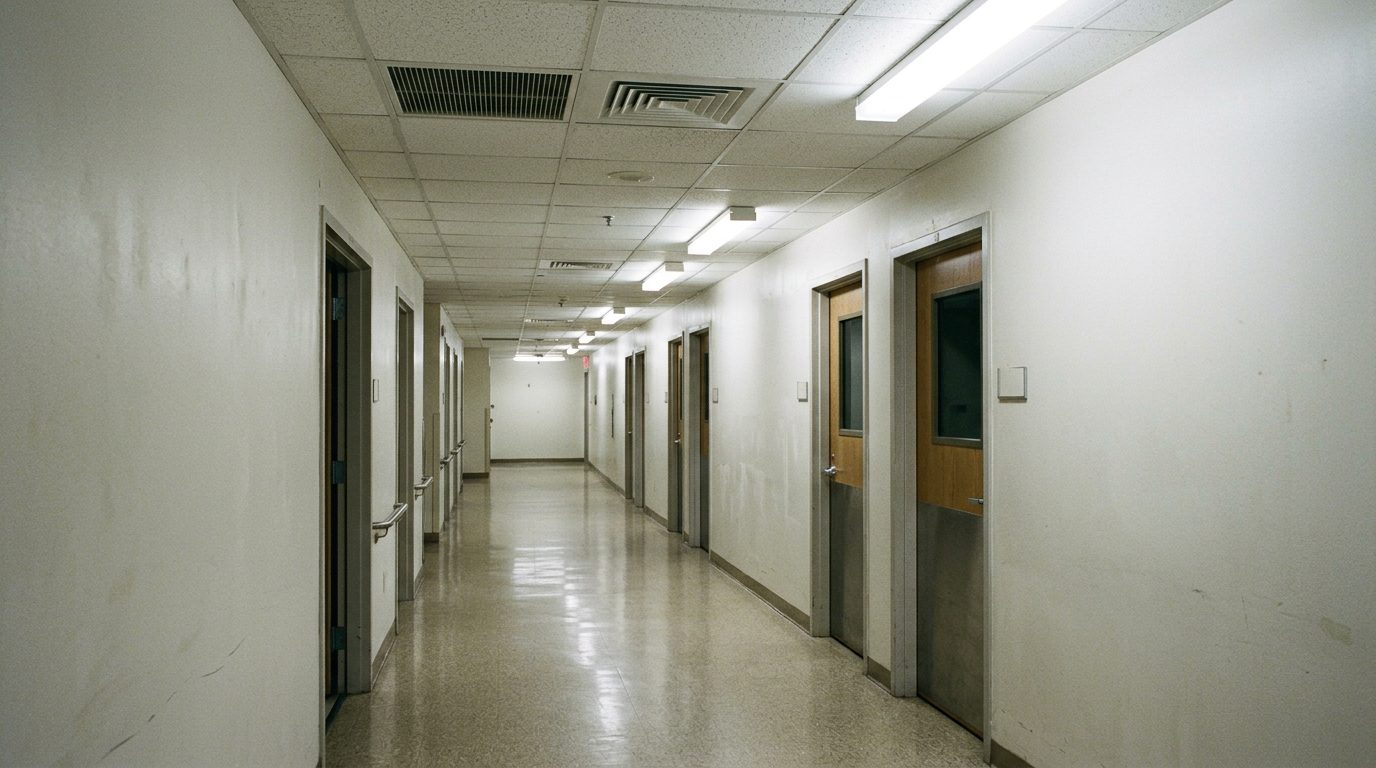
Hospitals
The notes describe the patient. Nobody described the room.
Clinical records are meticulous about care and silent about conditions. When an event is reviewed months later, the room has nothing to say for itself.
Four separate records exist around any incident. Clinical notes document the care. Building systems document the infrastructure. Sensors document whichever conditions somebody once chose to measure. Staff and patients remember what they noticed. These four are almost never aligned to one another, and the gaps between them are where reviews stall. We connect the physical conditions, room activity, operational systems, human observation and interventions around a defined event, on one clock.
The questions that follow
- ?What were the conditions in that room at that hour?
- ?Was the ventilation doing what it was set to do?
- ?How many people were present, and for how long?
- ?What maintenance or cleaning happened nearby?
- ?Did staff notice something before the record shows it?
- ?How long between the first signal and the first action?
- ?Has this recurred in the same space?
Give the room an environmental record without diagnosing the patient.
Give estates and facilities a room-condition chronology
What the monitored conditions were, in order, with the source of every entry.
Connect ventilation, maintenance, cleaning and occupancy
Place the building record and the staff record on the same clock.
Show when conditions changed
Identify the hour a departure from the normal pattern began, not the hour somebody reported it.
Show what action followed
The alert, who received it, and the intervention that was made.
Show whether conditions returned towards baseline
Record what the monitored parameters did after the intervention.
What this does not do
- —RippleXn does not detect infection or pathogens, and makes no diagnostic or clinical claim.
- —It does not confirm that a room is safe, and it does not replace occupational-hygiene assessment.
- —It does not replace certified medical or life-safety alarms.
- —Where a parameter was monitored, the finding is stated as follows: the specified monitored parameter remained within its defined range during the recorded period. Other unmeasured conditions are not excluded.
Where this applies
Who this is for
- Hospital estates and facilities teams
- Infection prevention and control teams seeking environmental context
- Occupational health and safety teams
- Ward and department managers responding to staff reports
- Quality, risk and incident review teams
- Contractors working adjacent to occupied clinical space
The specific problems we investigate
- Recurring chemical or unusual odours
- Ventilation performance or air-change deterioration
- Formaldehyde or other occupational exposure where validated instrumentation has been specified
- Cleaning or decontamination events
- Sewage or waste-related odours
- Particles and dust during adjacent construction
- Unexplained staff reports
- Environmental conditions surrounding a defined incident
What a qualified deployment can produce
- A room or area baseline
- A chronology of physical change on one clock
- Relevant building-management and ventilation records
- Human observations aligned to measurements
- Maintenance, cleaning or construction activity for the same window
- Alert and response timing
- Evidence of whether conditions returned towards baseline
- A written statement of anything that could not be established
What the evidence cannot establish on its own
- Any clinical or diagnostic conclusion
- Infection, its source or its transmission route
- Harm to a named patient or member of staff
- Occupational exposure limits without validated instrumentation specified for that purpose
- Anything about a room, period or parameter that was not monitored
A sensible first engagement
Hospital Environmental Exposure Snapshot
From €1,500
We map what your existing building-management, ventilation and reporting records could establish about a representative ward, department or defined environmental concern — and what would need to be measured to answer it properly, with a deployment that can expand across the estate.
See how engagements workProblems investigated in this sector
Technical capability, when the question requires it
Open +
Depending on the question and the validated configuration, a deployment may connect the following.
Not every deployment includes every parameter. The configuration is decided by the question, the site and what can be validated.
RippleXn makes no medical diagnostic claim. This does not replace clinical judgment, infection control procedure, or regulated medical devices. It describes the room, not the patient.
The second price tag
Examining the conditions around an event costs a known amount. An adverse event nobody can reconstruct costs whatever the inquiry decides it costs.